Radios
Seven radios, one box
A programmable baseband carries the cellular complex, and merchant modules carry HaLow, NR+, Wi-Fi, and Thread. Each module sits in a standard slot and can be replaced on its own.
Open Radio Basestation
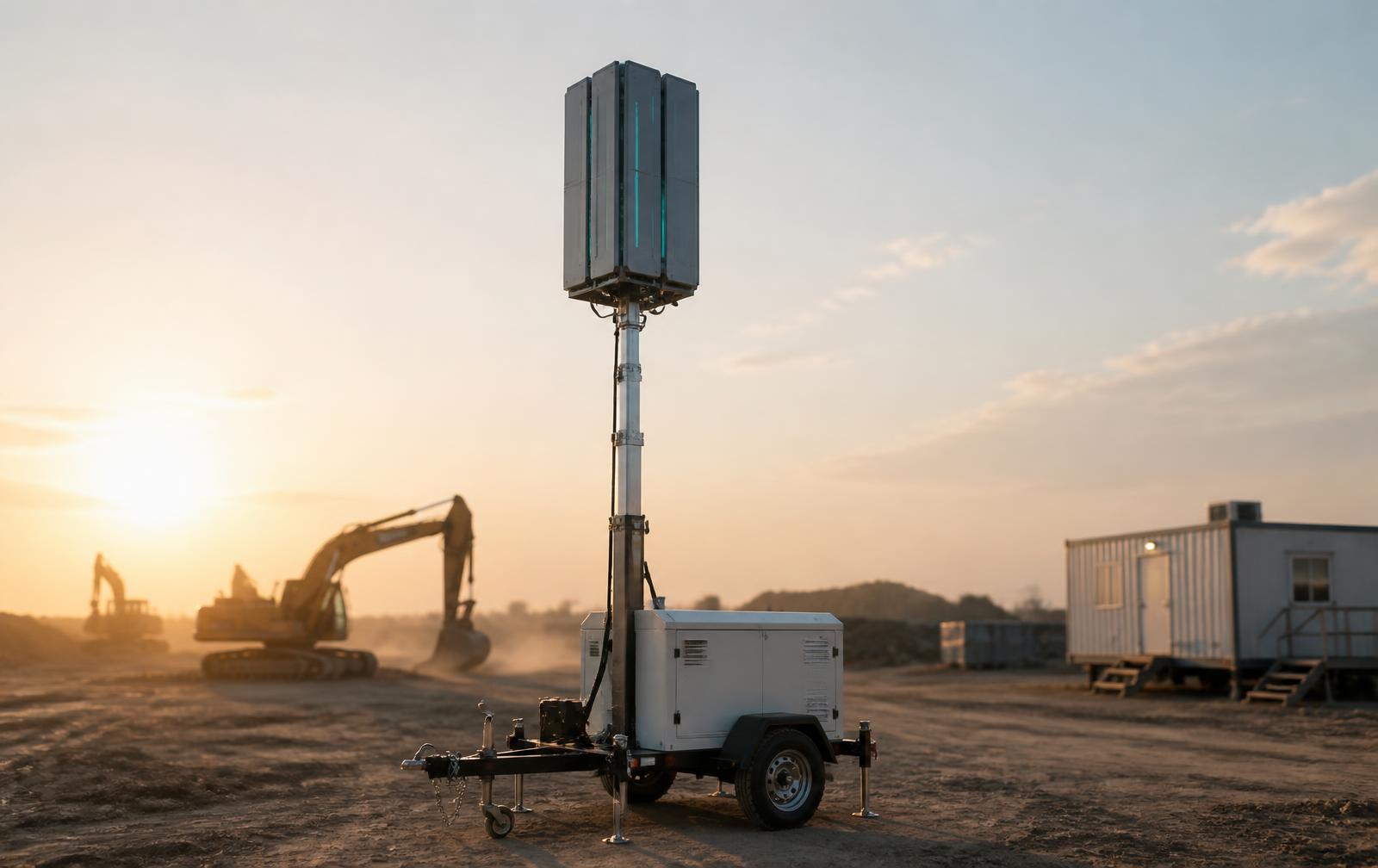
The ORB is a transportable base station that brings a real network to places that have none. It runs on open airwaves, coordinates its own permissions, and comes up in a morning.
Fast where the crews are, and still connected at the far end. Every tier degrades gracefully, never to zero.
| Tier | Range | Radios | Throughput |
|---|---|---|---|
| Around the trailers | 0 to 300 m | Wi-Fi 7 and CBRS | 2 to 4 Gbps aggregate |
| Across the site | 300 m to 2 km | CBRS with uplink-heavy frames | 1 to 2.5 Gbps, 300 to 500 Mbps up |
| Out at the tail | 2 to 10+ km | TV White Space and HaLow | 30 to 100 Mbps, degrading gracefully |
| Control tier | Site-wide | DECT NR+ mesh | Sub-5 ms latency class |
Targets from ORB-1 v0.9, subject to shared spectrum grants at your location.
Every tier above runs on open spectrum. Where a licensed floor is required, band n53 at 2483.5 to 2495 MHz is an option under the unit's panel, never a requirement.
Every layer of the ORB is an open interface, so nothing about your site depends on one vendor.
Radios
A programmable baseband carries the cellular complex, and merchant modules carry HaLow, NR+, Wi-Fi, and Thread. Each module sits in a standard slot and can be replaced on its own.
Coordination
One client architecture talks to the white space, CBRS, and 6 GHz databases. It requests, renews, and releases every transmission grant, and writes each one to a tamper-evident ledger.
Backhaul
Satellite, fiber, microwave, or carrier cellular, bonded and steered per flow with sub-second failover. Losing a path costs capacity, never connectivity.
Tenancy
Each organization gets its own slice across the radio, the access tier, and the WAN, with its own logins, priority, and accounting.
Power
Generator, shore power, or solar hybrid, with the same profile shared across the platform. Nothing about the site has to change first.
Carriers
The unit can carry participating carriers' subscribers over its own spectrum, so personal devices work on site and the emergency reachability gap closes.
Flagship for full site coverage, Compact for corridors and smaller jobs. Same software, same certifications, same behavior.
| Attribute | Flagship | Compact |
|---|---|---|
| Sectors | Three 120 degree sectors | One sector, aimed along the site long axis |
| Best for | Large sites, full site coverage | Corridors, small sites, satellite areas |
| Site aggregate | 6 to 10 Gbps target | Per-sector capacity of a Flagship |
| Compute | Class A local compute and storage | Class A or Class B |
Commissioning by non-specialist field personnel is not a convenience. It is a conformance requirement, and it is tested.
We will stage a pilot on a live job, or send ORB-1 to your engineers for review.