No filing
Spectrum coordination is automatic
The unit queries the coordination databases for its location, takes the channels it is cleared to use, and vacates them when the rules change. Nobody applies for anything.
Deployment
No survey, no integrator, no licenses. Park it, power it, raise the mast, scan the code. The site is online before the first break.
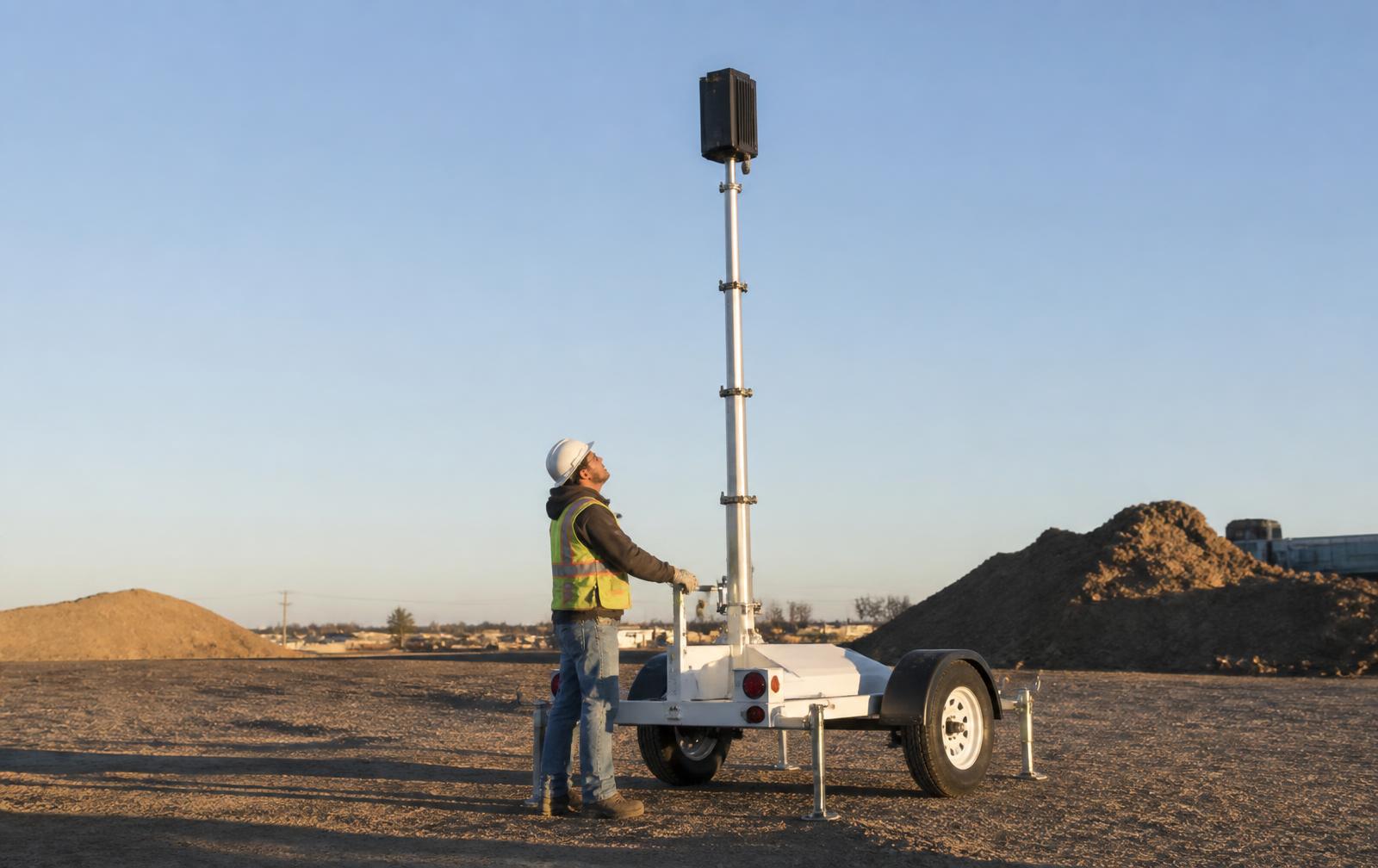
The morning
Times are from a standing start on ground nobody has surveyed. Most of it is waiting for a mast to go up.
Tow the unit to a spot with sky overhead and a view down the job. Anywhere works: laydown yard, edge of the pad, beside the trailers. Drop the jacks and level it.
Shore power from the trailer, a generator, or the unit's own solar and battery package. One cord, one breaker. Nothing to configure.
Crank the mast to height. Higher is farther, but the unit works at any height. One person, no lift, no ladder, no rigging.
The unit registers with the coordination databases on its own, learns which channels are clear at this location, and picks its band plan. This is the part that used to take an engineer and a filing.
Scan the QR on the door with a phone. Name the site, pick who gets on. Wi-Fi is live at the trailers and the site network is broadcasting.
Drive the perimeter with a phone in a cradle. The unit maps its own coverage and tells you where a machine-mounted Oasis would extend it. That is the whole survey.
What ships
What you provide
Why it is this simple
Everything that used to require a specialist is now the unit's job, not yours.
No filing
The unit queries the coordination databases for its location, takes the channels it is cleared to use, and vacates them when the rules change. Nobody applies for anything.
No survey
It measures its own coverage as you drive the site and reports where it is thin. A drive-around replaces a paid RF study.
No integrator
Backhaul, coverage, Wi-Fi, cellular, and the safety channel are one product with one configuration. There is no stack to wire together.
After day one
Jobsites change shape weekly. Nothing here is installed in the sense that it has to be uninstalled.
| Situation | What you do | What happens |
|---|---|---|
| Moving the unit | Lower the mast, hitch, tow | Comes back up with the same configuration. Minutes, not a redeployment. |
| Adding coverage | Bolt an Oasis to a machine | The machine joins the site network and starts covering the ground it works on. |
| Site office | Fixed-mount Oasis on the trailer | Wi-Fi, cameras, locks, and power monitoring in the office, on the same network. |
| Demobilization | Lower, hitch, tow | Nothing left behind. No cable to pull, no conduit to abandon, no contract to unwind. |
Pick a live job. We stage a unit and bring it up in a morning while you watch.